



The Numbers That Should Make You Stop Scrolling The affiliate marketing industry is sitting at over $17 billion; in the…




Ads are not the enemy.
Bad ad setups are.
If you’re searching for the best ad networks for blogs, you’re probably past the beginner phase. You already have traffic. You already publish consistently. And you’re finally asking the right question:
Which ad network actually pays—and which ones just waste impressions?
In 2026, ad monetization is no longer about slapping banners on your site and hoping for the best. The best ad networks for blogs now operate on quality signals, revenue tiers, audience value, and technical performance. Some reward authority. Others punish impatience. A few quietly outperform everything else—if you know when to use them.
This guide breaks down the top-performing ad networks, who they’re for, and how to choose the right one based on your traffic stage.
Before jumping into the list, let’s clarify expectations.
The best ad networks for blogs today:
This means your monetization choice should change as your blog evolves. What works at 50K sessions may limit you at 500K. Choosing wrong can cap earnings for years.
This list is ordered strategically, not alphabetically.
Google AdSense is usually where blog monetization begins—and for good reason. It’s the most recognizable name in the space and often a blogger’s first real exposure to earning money from content. Among the best ad networks for blogs, AdSense plays the role of the foundation, not the finish line.
What makes AdSense so widely used is scale. Its massive advertiser ecosystem allows it to fill ad inventory across almost any niche, from personal blogs to highly specialized content sites. That reach translates into consistent ad delivery, even when traffic is still growing.
AdSense relies on contextual targeting, meaning it scans your content and automatically serves ads that align with what readers are already engaging with. Setup is straightforward: once approved, you drop in a few lines of code and Google handles ad delivery, placement logic, and payments behind the scenes.
It also supports multiple formats—display ads, text-based units, and native-style placements—making it easy to integrate ads without redesigning your site. Reporting is another strong point. AdSense dashboards give clear visibility into performance by page, placement, and content type, which helps bloggers understand what’s working early on.
As traffic grows, limitations become more obvious. RPMs are generally lower than what premium platforms offer, and optimization control is minimal. Revenue tends to flatten once a blog reaches a certain scale, especially when compared to more advanced options among the best ad networks for blogs.
Payment terms are reliable but conservative, with a $100 payout threshold and monthly payments via direct deposit, wire transfer, or check. It’s stable—but not aggressive.
Google AdSense works best as an entry-level monetization layer. It’s ideal for:
AdSense isn’t built to maximize long-term earnings, but it does one thing exceptionally well: it gets you monetized quickly with minimal friction. Think of it as the training wheels phase before graduating to higher-performing options within the best ad networks for blogs ecosystem.
When your traffic starts hitting mid-to-high five figures, you enter the “Pro League.” These networks focus on high-intent US/UK/Canada audiences and offer the highest payouts.
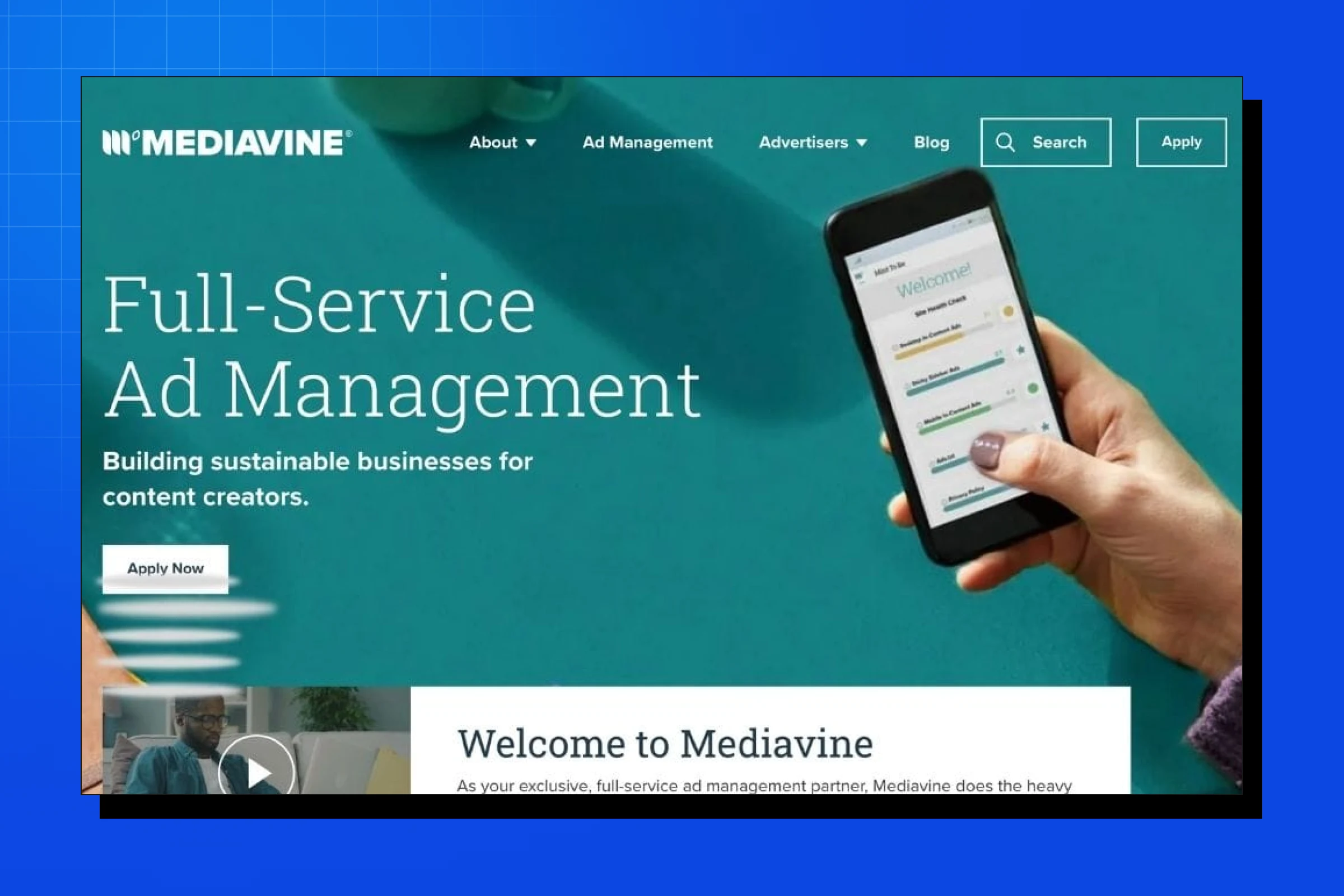
Mediavine is consistently ranked among the best ad networks for blogs because they prioritize your site’s health.
This network operates in the premium lane for a reason:
Instead of flooding pages with clutter, Mediavine focuses on placement intelligence, making ads work with your content, not against it.
Mediavine favors blogs that:
If your audience treats your blog like a resource instead of a scroll-by, you’re already aligned with how the best ad networks for blogs operate in 2026.
The 50,000 monthly session requirement isn’t gatekeeping—it’s positioning. By working only with established blogs, Mediavine protects advertiser trust, which directly translates into better payouts for publishers.
Once you’re in, you’re not left to figure things out alone. You get:
Payments are also refreshingly reasonable, with a low payout threshold and predictable cycles—something growing bloggers appreciate more than they admit.
If your blog already feels polished, intentional, and audience-first, Mediavine often becomes the moment where ads stop being “extra money” and start feeling like real income.
That’s why Mediavine consistently ranks among the best ad networks for blogs—not because it’s flashy, but because it scales without punishing growth.

Raptive is designed for publishers who want aggressive revenue scaling. It remains one of the best ad networks for blogs operating at high traffic volumes.
Raptive focuses heavily on maximizing yield per session. The platform enforces strict site standards, which protects advertiser trust and increases CPMs.
If your blog is already performing like a media asset, Raptive provides infrastructure to scale ad revenue predictably.
Not quite at 50k sessions yet? Don’t worry, the “Blogging Mid Class” is thriving with these options.
Ezoic is for the data nerds who want to automate their success.

Ezoic continuously experiments with layout variations to identify the optimal balance between revenue and user experience.
For blogs transitioning from beginner monetization to professional revenue, Ezoic offers flexibility and growth potential.

Journey fills the gap between entry-level platforms and premium networks.
Monumetric works well for blogs that have outgrown AdSense but are not yet eligible for top-tier networks.
For bloggers who want guidance without sacrificing monetization potential, Monumetric is a strong option.
Sometimes, standard display ads aren’t enough. To truly maximize your bag, you might layer these in:

Media.net offers contextual advertising powered by Yahoo and Bing, positioning itself as an alternative to Google-based platforms.
Good performance for search-driven blogs
It works particularly well for finance, technology, and business content with high-intent keywords.

Infolinks specializes in in-text and contextual formats that complement traditional display ads.
It’s not a primary solution but enhances revenue when layered strategically.

PropellerAds offers pop-unders, push notifications, and interstitials.
While controversial, it remains one of the best ad networks for blogs targeting specific geographies.

While not a traditional display network, integrating a niche job board via artha.link is the 2026 move for “Authority” blogs to add a massive passive income stream alongside their ads.By using artha.link, you can launch a branded job board with just one link, no code, no ops headache, no recruiting team required. Your blog becomes a talent hub, not just an information site.
This monetization method can make you go from 0 to 1 Dollar in just one day literally. You don’t have to go look for job listings, we already have a pool of 4M+ job ads ready to backfill as per your niche.
Join the waitlist.
| Network | Min. Traffic | Best For |
| Raptive | 25k-100k views | High-Scale Media |
| Mediavine | 50k Sessions | Lifestyle, Food, DIY |
| Ezoic | None (1k rec.) | Data & UX Nerds |
| Journey | 10k Sessions | Fast-Growing Blogs |
| Media.net | 10k-30k views | 10k-30k views |
| Google AdSense | None (Zero) | Beginners |
| Artha.link | 10K+ Followers | Authority Niche Hubs |
| Infolinks | None (Zero) | Text-Heavy Content |
| PropellerAds | Zero | Global/Viral Traffic |
Avoid choosing solely based on entry requirements. Long-term scalability matters more.
Across the best ad networks for blogs, realistic RPM ranges look like this:
Even with the best ad networks for blogs, these mistakes kill income:
Strategic restraint often earns more than aggressive monetization.
Advertising continues shifting toward:
Blogs that invest in audience trust and infrastructure will continue to outperform.
The best ad networks for blogs in 2026 reward clarity, consistency, and quality.
Ads are not outdated. Poor choices are.
Pick a network that grows with your blog, protects your audience experience, and aligns with your monetization roadmap.