

The creator economy has a transparency problem. Everyone talks about six-figure deals and passive income, but the full picture is…

You’ve seen the headlines. A 22-year-old making six figures from TikTok. A gaming YouTuber is buying a house with ad revenue.


You’ve seen the headlines. A 22-year-old making six figures from TikTok. A gaming YouTuber is buying a house with ad revenue. A finance Instagram page landed a $10,000 brand deal. And you’re sitting there thinking, okay, but what’s the real number? What does the average creator actually take home?
Let’s skip the hype and get into the actual numbers. If you’ve ever wondered how much money do content creators make, whether you’re just getting started or you’ve been posting for a while, this breakdown is going to give you the clearest picture on the internet right now.
Fair warning: the numbers vary a lot depending on where you post, what you talk about, and how you monetize. Let’s go platform by platform.
How Much Do Content Creators Make Across Every Major Platform?
Before we get into the platform breakdowns, here’s the thing nobody tells you: two creators with the exact same follower count can have completely different bank accounts at the end of the month.
A lifestyle creator with 40K Instagram followers might pull in $8,000 from a single brand deal. A meme page with 400K followers on the same platform might earn $300 from a shoutout. Same platform, ten times the audience, a fraction of the income.
Creator income is shaped by your niche, your engagement rate, your audience’s location, your posting consistency, and, most importantly, how many income streams you’ve built.
Platform payouts are just one piece. Brand deals, affiliate income, digital products, community memberships, and job-based monetization (more on that later) all stack on top.
Keep that in mind as we walk through every major platform below.
YouTube remains the strongest platform for long-term monetization, and the ad revenue model here is miles ahead of every other platform.
Once you hit 1,000 subscribers and 4,000 watch hours, you qualify for the YouTube Partner Program and start earning from ads. The key metric is CPM, cost per 1,000 views, which tells you how much advertisers are paying to reach your audience.
A mid-size YouTuber with 100K subscribers generating around 150K views per month in the finance niche could realistically earn $3,000–$5,000/month from ads alone before a single brand deal.
But here’s what makes YouTube really powerful: creators don’t stop at ad revenue. Channel memberships, Super Thanks, merchandize shelf, affiliate links in descriptions, and sponsored integrations can easily be 3–5x what the ads bring in. A creator earning $3K from YouTube ads might be pocketing $12K–$15K total once you add everything else.
YouTube takes time. Most creators don’t hit monetization thresholds for 12–18 months. But once you’re in, the compounding effect of evergreen content videos that keep getting views for years makes it the most sustainable long-term income platform there is.
TikTok is where careers explode overnight. It’s also where a lot of creators get a reality check when they check their creator fund earnings.
The original TikTok Creator Fund was genuinely terrible, paying as little as $0.02–$0.04 per 1,000 views. The Creativity Program Beta, launched to replace it, is a step up but still nowhere near YouTube levels.
The smart TikTok creators treat the platform as a top-of-funnel audience machine, not a paycheck. They use TikTok to build a following fast, then drive that audience to YouTube, newsletters, digital products, or affiliate links where the real money lives.
If you’re relying purely on TikTok’s native payouts, you’re leaving the majority of your earning potential on the table.

Instagram’s native monetization through Reels bonuses and badges on Lives has been inconsistent at best in 2025. Meta has scaled back several creator bonus programs, and many creators report their Instagram-direct income dropping significantly compared to 2022–2023.
But that doesn’t mean Instagram isn’t lucrative. It’s just lucrative in a different way.
Instagram is the brand deal capital of the creator economy. It’s where product sponsors go first, especially in lifestyle, beauty, fashion, fitness, food, travel, and parenting niches.
The visual nature of the platform makes it perfect for product placement, and engagement rates, especially in micro-influencer territory, tend to be higher than on on other platforms.
One important thing: engagement rate beats follower count on Instagram every single time. A micro-creator with 25K followers and a 6% engagement rate will get more brand inquiries and be able to charge more than a bloated account with 200K followers and 0.5% engagement. Brands have gotten smart about this.
Facebook doesn’t get the creator hype that YouTube and TikTok do, but it’s quietly one of the better platforms for monetization especially for creators who already have an older US-based audience.
Facebook’s In-Stream Ads program lets creators earn from ads placed in their videos, similar to YouTube. The CPMs are decent, particularly for US audiences, and Facebook has a massive user base of 35–65 year olds with higher disposable income than TikTok’s core demographic.
Facebook also rewards repurposed content well. Many creators cross-post their YouTube or TikTok content to Facebook and earn a secondary revenue stream with zero extra effort. If you’re not doing this, you’re leaving money on the table.
X has rolled out several monetization features since Elon Musk’s acquisition, with varying degrees of success.
Tips: one-time payments sent directly to creators
Honest take? X isn’t a primary income platform for most creators yet. It’s best used as an audience-building and authority tool, especially for creators in finance, tech, politics, and business, with monetization happening through affiliate links, newsletter sign-ups, and product sales driven by that audience.
LinkedIn is becoming one of the highest-ROI platforms for a specific type of creator, particularly those in business, HR, marketing, finance, career coaching, and tech.
LinkedIn doesn’t pay creators directly through ad revenue. But the platform is incredibly powerful for:
The creator with 15K LinkedIn followers in the recruitment space can out-earn someone with 150K TikTok followers because every single follower is a professional with purchasing power and a company credit card.
Here’s where we have to talk about something that doesn’t show up in most creator income guides.
If your content touches on careers, finance, trucking, sales, professional growth, or any business-adjacent topic, your audience is almost certainly job hunting, upskilling, or actively trying to level up their income. That’s an enormous amount of career intent sitting in your audience, and most creators are monetizing exactly zero of it.
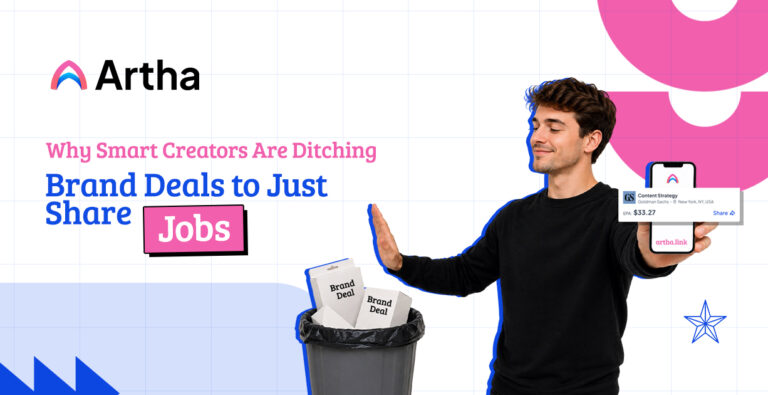
That’s the gap artha.link fills. It’s a creator monetization tool that gives you a personalized link with thousands of preloaded niche-specific jobs to share with your audience. Every time a follower applies to a job through your link, you earn.
The AI refreshes your job listings daily that match your niche, setup takes under 2 minutes, and it’s completely free to start. You’re already influencing career decisions in your audience artha.link just makes sure you actually get paid for it.
How much money do content creators make? Anywhere from near-zero to millions, and that’s not a dodge; it’s just the truth of a career path where strategy beats luck every time.
The creators winning in 2026 aren’t waiting for a brand to DM them or a video to go viral. They’re building income stacks that work across platforms, across niches, and across multiple revenue streams, so one algorithm change doesn’t send their income to zero.
If you haven’t explored what your audience’s career intent is worth, now’s a good time to start.
Try artha.link now
Most full-time creators earn between $50,000 and $100,000 annually. Part-time or newer creators typically earn under $20,000/year. The range widens dramatically based on niche, platform, and number of active income streams.
From TikTok’s Creativity Program, expect $1,000–$5,000/month from views. The real money is in brand deals. At 1M followers, a single sponsored post in a premium niche can bring in $10,000–$50,000.
YouTube consistently delivers the highest per-view payouts through its ad program, especially in high-CPM niches. For brand deals, Instagram and LinkedIn often pay more per post than any other platform.
Yes, and often more efficiently than large accounts in the wrong niche. A creator with 8,000 highly engaged followers in finance or career content can out-earn someone with 80,000 passive entertainment followers through the right affiliate programs, digital products, and audience-intent tools.