

You've probably heard passive income for creators thrown around so many times that it's started to sound like a myth.…

The creator economy just crossed $250 billion, and most creators are seeing almost none of it.


The creator economy just crossed $250 billion, and most creators are seeing almost none of it. Not because the opportunity isn’t there, but because the average full-time creator is still working 11-hour days, chasing brand deals, and relying on income that disappears the moment they stop showing up. The fix isn’t working harder. It’s building income streams that don’t need you to be online to keep running.
That’s exactly what this guide covers; the passive income ideas for 2026 are actually delivering creators who are done depending on the algorithm. Digital products, online courses, and one more move most creators overlook entirely.
Physical products come with inventory, shipping logistics, and storage costs. Digital products have none of that overhead. You build something once, and it can sell a thousand times. The economics are hard to argue with.
A Notion template built over a weekend can generate sales for years. A well-written PDF guide on your area of expertise can bring in consistent income long after you’ve moved on to your next project. The effort is front-loaded; the returns aren’t.
Here’s a look at the most common digital product types and what each one realistically involves:
| Digital Product Type | Time to Create | Skill Required | Earning Potential |
| Templates (Notion, Figma, Canva) | 2–10 hours | Moderate | $5–$97 per sale |
| eBooks / PDF Guides | 5–20 hours | Writing / Expertise | $9–$49 per sale |
| Stock assets (icons, fonts, photos) | Varies | Design / Photography | $1–$30 per download |
| Presets & Filters | 3–8 hours | Editing skills | $10–$79 per pack |
| Online Courses | 20–80 hours | Teaching + expertise | $49–$999+ per sale |
| Curated job links for your audience | 5 min to launch | Nothing if you have a community | $26-$40 per application, depending on niche |
For most creators just getting started, templates and PDF guides are the practical entry point. The creation time is low, the price point is accessible for buyers, and the value is immediately obvious.
If people regularly ask you how you do what you do, that’s the clearest possible signal that a course is worth building.
The thing that separates courses that sell from courses that sit is structure. Raw expertise alone doesn’t convert. What buyers are actually paying for is a clear outcome: they want to go from point A to point B, and they want someone to show them the path. Your job is to lay that path out in a way that feels manageable.
Once a course is live and the early feedback loop is done, it becomes genuinely low-maintenance income. You tweak it occasionally, but the day-to-day selling handles itself, especially if you have the right platform underneath it.
This one doesn’t get talked about enough, and it should.
If you’ve built an audience around a specific niche, design, marketing, tech, finance, healthcare, or anything, the people following you are professionals in that space. They trust your recommendations. They’re already asking you what tools to use, what skills to learn, what to read. At some point, some of them are also figuring out their next career move.
That’s where this gets interesting.
Creators who share a curated link with their audience, pointing them toward relevant job opportunities in their niche, are adding real value for their followers while opening up a new income stream for themselves. Companies pay to reach engaged, niche audiences. Your followers get opportunities that are actually relevant to them. Everyone benefits.
This kind of stream generates income through paid access for companies wanting visibility with your audience, featured placements, and subscription tiers for followers who want early or exclusive access to listings.
The passive element kicks in once it’s established. Companies come back because the audience converts. Followers come back because the opportunities are good. You’ve essentially built a trusted resource that pays you to maintain it.
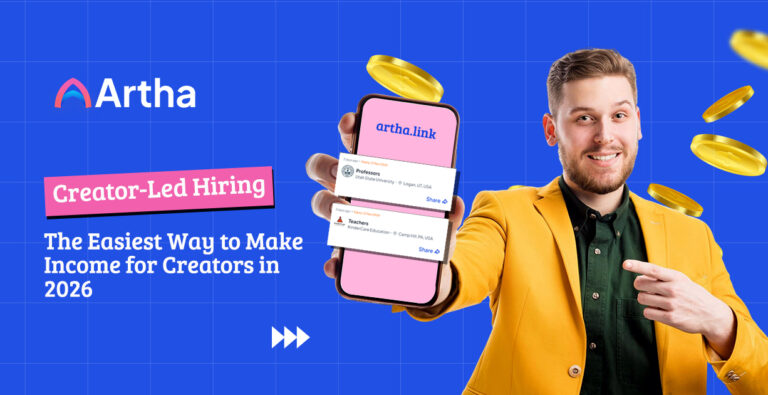
Setting this up used to require custom development but with artha.link on your side, all you need is max 10 min and your custom branded link with thousands of job boards are already live. All you need to do is to share that link with your audience.
Having a great digital product or a course idea means very little if there’s no clean system to sell it, collect payments, and manage buyers. This is where a lot of creators stall, not because they lack ideas, but because the operational side feels like too much to figure out.
The simplest solution is consolidating everything onto one platform rather than stitching together separate tools for payments, product delivery, course hosting, and audience management.
The right answer depends on where you are right now as a creator.
The gap between having an idea and actually making money from it has never been smaller. AI tools speed up content creation. No-code platforms handle the technical side. Payment infrastructure works globally and settles fast.
What that means practically is that the digital product income ideas that would have taken months to execute a few years ago now take days. The barrier isn’t skill or access anymore; it’s just starting.
The creators building real creator-focused passive income right now aren’t necessarily the most talented ones in their niche. They’re the ones who stopped waiting for the perfect moment and built something with what they already had.
Building passive income as a creator in 2026 is less about finding a secret strategy and more about picking one of the proven ones and actually following through. Digital products, courses, and helping your audience access the right opportunities, these aren’t new ideas. What’s new is how accessible the tools are to execute them properly.
Pick the stream that fits where you are right now. Build it well. And to be honest the most easier way to make one consistent income has to be artha.link.
No, and this is probably the most common misconception. A small, engaged audience that trusts you will always outperform a large, disconnected one when it comes to conversion.
Most creators see their first sales within a few weeks of launch if they actively promote. The truly hands-off phase, where income comes in without active pushing, usually takes three to six months of building organic reach, SEO, or platform presence. It’s a slow build that pays off over time.
Look at your competitors, but don’t race to the bottom. If your product saves someone 10 hours of work, price it based on the value of that time saved.
Yes, artha.link do everything for you, all you need to do is click on the sign up button.
Not necessarily. Low prices can actually signal low value and attract buyers who are harder to satisfy. Start with a price that reflects the outcome your product delivers, and offer a launch discount if you want early momentum. It’s much easier to lower a price later than to raise it after you’ve established a low anchor.