


The honest answer: anywhere from almost nothing to several million rupees a year. The slightly less glamorous answer is that…

You spent last week chasing a brand for a late payment. Or stressing because your latest video tanked in the algorithm. Or half-outlining a course you genuinely don’t have the energy to finish.


You spent last week chasing a brand for a late payment. Or stressing because your latest video tanked in the algorithm. Or half-outlining a course you genuinely don’t have the energy to finish.
The content treadmill is exhausting, and the monetization models that come with it aren’t much better because almost all of them ask you to do more. More content. More pitching. More managing. More.
But some niche creators have quietly found something that asks almost nothing of them. They’re not pushing products they don’t use. They’re not selling merch. They’re sharing job openings with their community and getting paid every time someone applies.
It’s called creator-led hiring, and it has nothing to do with becoming a recruiter.
Let’s be brutally clear: you are not a recruitment agency. You don’t read resumes. You don’t interview anyone. You don’t jump on awkward client calls or guarantee hires.
You are the middleman of trust.
Your audience already has a professional identity; they’re designers, engineers, marketers, operators, or something else specific. Companies want to hire that exact type of person. You just happen to have their attention.
artha.link automatically fetches high-paying, verified open roles based on your specific niche. It generates a link, to your link. You share it with your community. Someone clicks, someone applies, you earn a CPA (Cost Per Application) payout. The company handles everything after the click.
You’re not building a job board. You’re not manually sourcing listings. You’re not managing anything. You’re sharing a link that does the work.
Lenny is a former Airbnb PM who built one of the most trusted newsletters in the product management space, with over a million subscribers and multiple millions in annual revenue. But subscriptions and ads aren’t the only things working for him.
He runs a curated job hub on the side. Tech companies pay to surface their open roles to his audience because they know Lenny’s readers are exactly the kind of talent they can’t find on LinkedIn. Lenny doesn’t vet candidates. He doesn’t do background checks. He’s just the high-signal filter, and companies pay a premium to be in front of that filter.
His audience trusts him. That trust is the product. Everything else is just distribution.
Gergely’s newsletter has over 400,000 subscribers and sits at the top of Substack’s technology charts. When he launched a curated job layer for senior software engineers, companies started telling him they were getting faster, better results than anything they’d tried on traditional job platforms.
The reason wasn’t magic; it was specificity. The engineers who read The Pragmatic Engineer are senior, intentional, and actually good. That audience quality is what companies were paying for.
Ben built the go-to community for no-code builders. When you own the community for a specific skill set, companies don’t go to LinkedIn to find that talent they come to you. Ben ran a job layer for exactly that niche. It became part of what made Makerpad valuable enough to get acquired by Zapier.
The thread across all three: trust in a specific niche, turned into a distribution advantage, turned into income.
You don’t need a million followers. You need the right followers, a concentrated, niche audience with a shared professional identity. A micro-creator with 3,000 engaged software developers will drive far more qualified applications than a lifestyle creator with 500,000 generic followers.
Here’s a look at who’s positioned to do this right now and what roles are actually trending:
| Creator Type | Trending Niche Jobs Right Now | Why It Converts |
| Tech & Dev Creators | AI/ML Engineers, Full-Stack Devs, DevRel | Massive global talent shortage — companies pay premium CPA for vetted devs |
| Design & Creative Minds | UI/UX Designers, Motion Animators, Brand Artists | High-turnover industry; startups constantly hiring, high click-to-application rate |
| Marketing & Growth Experts | Performance Marketers, SEO Strategists, Ghostwriters | Huge volume of open roles; brands desperate for modern growth talent |
| Business & No-Code Operators | Fractional COOs, Automation Specialists, PMs | High-salary roles with premium payouts per valid application |
| Manufacturing & Industrial Creators | CNC Machinists, Robotics Technicians, Plant Managers | Deep skilled-labor shortage; companies pay for high-signal applicants from trade creators |
| Trucking & Logistics Influencers | CDL Drivers, Fleet Dispatchers, Logistics Analysts | Permanent industry deficit; constant listings mean predictable, recurring CPA income |
| Finance & FinTech Analysts | Quant Analysts, FinTech PMs, Fractional CFOs | Premium fees, low generic-applicant tolerance — niche audiences win every time |
| Healthcare & Medical Creators | Telehealth Nurses, Medical Scribes, Health-Tech Admins | High-volume, constantly refreshed listings across remote care and specialized clinics |
The question to ask yourself is: does my audience do something professionally, and are companies looking for people who do that thing? If yes, you’re already sitting on this.
If you’ve thought about the jobs model before, you’ve probably imagined two options: mention roles in your newsletter, or build a proper job board. Both work kind of. But both come with real friction.
Dropping jobs in your newsletter: You write the copy, paste the links, pray the formatting holds, and hit send, and that’s it. One send, one moment of visibility, no tracking, no dedicated place for it to live. The company has no idea if it worked. You have no idea if it worked. Next issue, you start from zero.
Building a traditional job board: Now you’re a data-entry clerk. You’re chasing companies for flat listing fees, manually uploading roles, deleting dead links, maintaining a website, and figuring out payment infrastructure. That’s not passive income; that’s a second job you didn’t apply for.
artha.link: You get a single, shareable link your link that automatically pulls in verified, niche-relevant job listings without you lifting a finger. Drop it in your bio, your newsletter footer, your community’s pinned post. It lives there permanently, updates daily, and works every time someone clicks it.
No building. No manual uploading. No admin. Just a link that does the job.
The biggest trap creators fall into is building an income stream they end up resenting because it quietly becomes a part-time job. artha.link is designed specifically not to be that.
Here’s what runs on autopilot:
Automatic job fetching: artha.link sweeps the internet and pulls in high-paying, verified open roles tied to your specific niche. You don’t source them. You don’t hunt them down.
Hyper-relevant curation: Listings are matched to what your audience actually cares about, not a generic dump of every open role on the internet.
Daily automatic updates: Jobs expire, new ones open up. artha.link refreshes your page daily without you clicking a single thing. Your link is always current.
What this means practically: you film a 15-second video or drop a tweet “hey, three major remote companies just opened senior roles in our niche, links on my page” and the link you’re pointing to is already up-to-date, already relevant, already working. You don’t prep anything. You just point.
“Okay, but how does anyone know an applicant came from me?”
This is where the system earns its keep.
The second someone taps a job link on your page, artha.link tags them with a unique ID that follows their entire application journey. One click. One ID. One trail that leads back to your account. There’s no guessing, no manual tracking, and no spreadsheet detective work.
But it doesn’t just count every click blindly; there’s a filter.
Before a click counts toward your earnings, it passes through what artha.link calls the Bouncer. The Bouncer automatically flags and blocks fake bot traffic, clicks from wrong geographic regions, and people spamming the same link repeatedly. None of that junk makes it through.
What shows up in your dashboard is 100% real, high-intent talent. That’s how your CPA payouts stay clean and predictable: you get paid for real applications, not inflated vanity numbers.
No UTM headaches. No manual follow-ups with companies. No “I think a few people clicked.” Just receipts.
You’ve been building trust with a specific group of people for months, maybe years. That trust has a market value you’ve never directly captured.
Companies want to reach your people. Your people want to find good opportunities. You’ve been sitting in the middle of that equation this whole time just without a link.
artha.link is the link. One shareable URL that auto-fetches your niche’s jobs, stays current every single day, tracks every application back to you, and pays you for every real one that comes through.
You stay the creator. The link does the rest.
Ready to see what your audience is actually worth? [Launch your link at artha.link ]
Not at all. You’re completely removed from the hiring transaction. Your only job is to point your audience toward relevant open roles. The interviewing, vetting, and all hiring decisions are handled entirely by the company’s internal team. You’re a curator, not an HR rep.
Trust and depth matter far more than follower count. A micro-creator with 3,000 highly engaged software developers will drive more qualified applications than a massive creator with 500,000 generic followers. If people come to you for niche industry insights, your audience is already big enough to start.
CPA stands for Cost Per Application. Instead of charging companies an upfront flat fee to list a role (which they may or may not pay), you earn a set payout every time a qualified candidate from your community submits a legitimate application through your link. It’s performance-based, scalable, and low-risk on both sides.
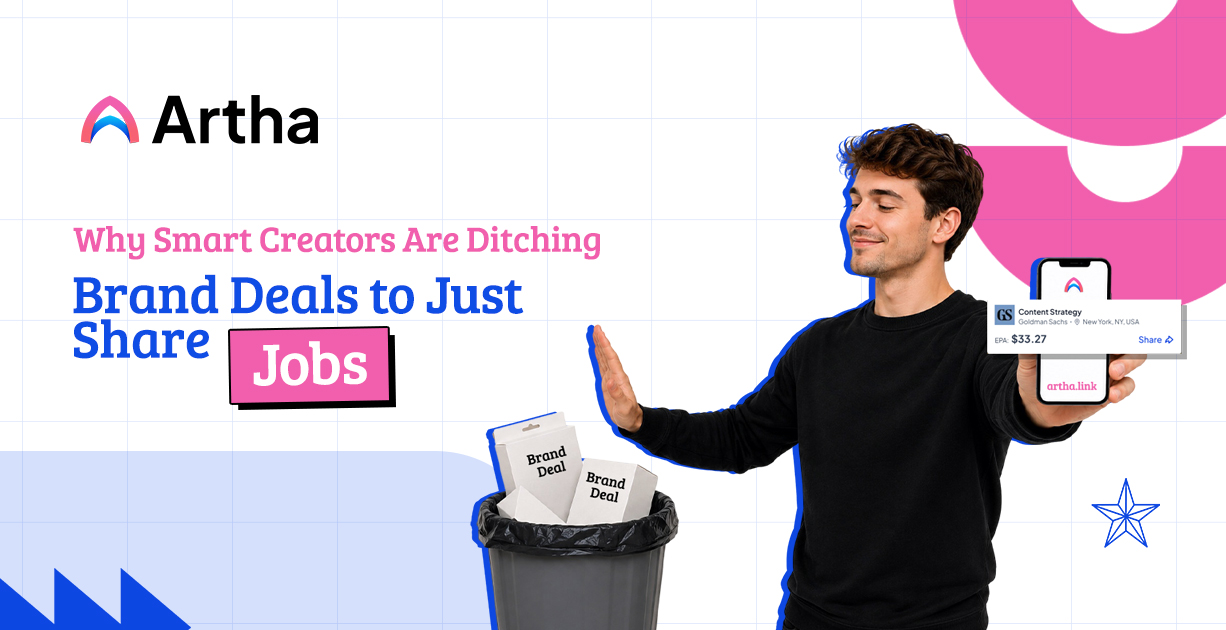
It’s actually the opposite. When you push a brand deal for an app you barely use, your audience clocks it as an ad. When you share high-paying, relevant job openings in their exact field, they see it as a resource. You’re helping them advance their careers, which builds goodwill, not resentment.
Absolutely. This isn’t a replacement for brand deals; it’s the baseline that runs underneath everything else. Brand budgets fluctuate, campaigns end, and sponsorship pipelines dry up seasonally. People, on the other hand, are always looking for jobs. Your artha.link keeps earning quietly in the background, 365 days a year, regardless of what else is going on with your content calendar.